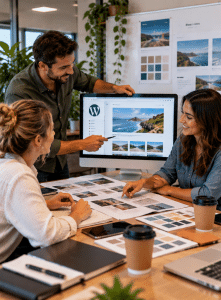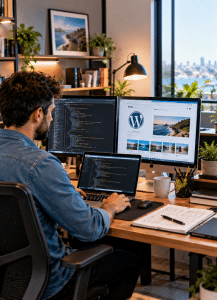

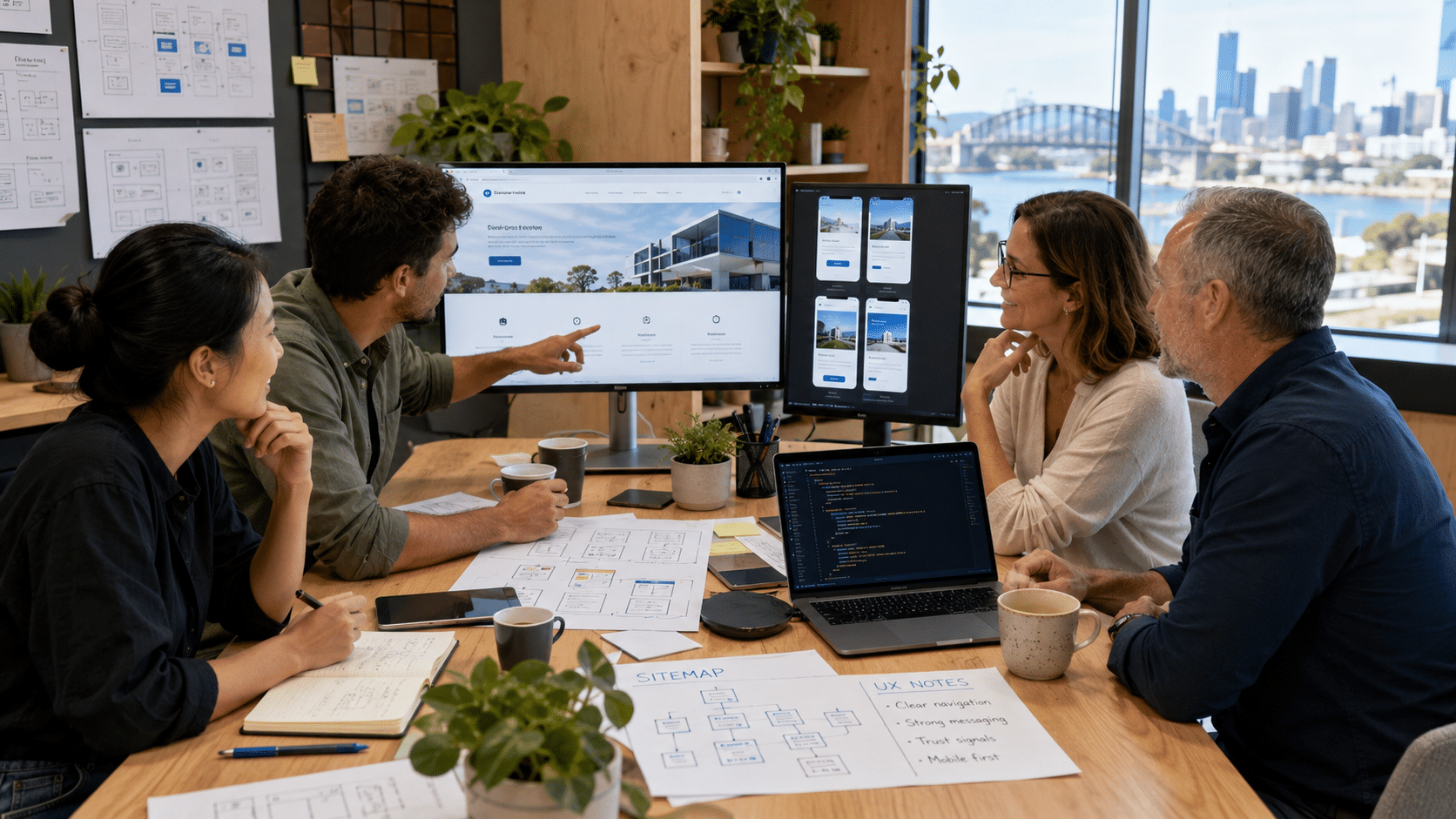
Australian businesses searching for web design development usually want more than a good-looking website. They want a site that loads fast, builds trust, explains their offer clearly, works on mobile, supports Google visibility, and turns visitors into leads or customers. From my experience reviewing small business websites, the strongest results come when design, development, SEO, content, analytics, and ongoing maintenance are planned together from day one.
Table of Contents
- Featured definition: What is web design development?
- Why web design development matters in Australia
- Web design vs web development: what is the difference?
- What a strong Australian business website needs
- The web design development process
- Onshore vs offshore web design development
- SEO and content planning for web design development
- Technical foundations: speed, security, accessibility, and tracking
- Common mistakes Australian businesses should avoid
- People Also Ask
- Expert Q&A
- Conclusion
What is web design development?
Web design development is the combined process of planning, designing, building, testing, launching, and improving a website. Design shapes layout, branding, user experience, and content flow. Development turns those plans into a working site with clean code, fast loading, mobile usability, SEO foundations, security, integrations, and ongoing support.
Why web design development matters in Australia
Australia is a mature digital market. Customers compare businesses online before they call, book, buy, or request a quote. Therefore, a website is often the first proof that a business is credible.
According to DataReportal’s Digital 2026 Australia report, Australia has high internet adoption and strong mobile use, which means most prospects can research, compare, and judge a business online before speaking to a salesperson. The Australian Bureau of Statistics also reports on technology use, innovation, skills shortages, and cyber security incidents through its business characteristics releases, which shows why digital capability is now part of normal business operations rather than a “nice to have” project.
For Australian service businesses, web design development affects several commercial outcomes.
First, it shapes trust. A clear website with consistent branding, local contact details, transparent services, and useful content reassures visitors that the business is real and organised.
Second, it affects search performance. Google needs crawlable pages, useful content, logical headings, internal linking, structured information, fast loading, and mobile-friendly layouts to understand and rank a website.
Third, it affects conversion. A visitor may like your service but leave if the page is slow, the offer is vague, the form is too long, or the call to action is hidden.
Finally, it affects long-term maintenance. A poorly built website can become expensive to update. However, a well-planned site gives your team a cleaner foundation for future campaigns, landing pages, analytics, and integrations.
Web design vs web development: what is the difference?
Many people use “web design” and “web development” as if they mean the same thing. They overlap, but they are not identical.
Web design focuses on the visual and experience layer. It includes layout, typography, colour, imagery, spacing, navigation, content hierarchy, user journeys, and how the site feels to visitors.
Web development focuses on the technical build. It includes front-end code, CMS setup, performance, forms, integrations, security, database structure, hosting, and maintainability.
In practical web design development, the two disciplines should work together. A beautiful design that is hard to build can become slow and fragile. Likewise, a technically clean website with poor messaging can fail to convert. Therefore, Australian businesses should judge a website project by both presentation and performance.
Key parts of web design development
A complete project usually includes:
- Discovery and business goals
- Competitor and audience research
- Website structure and sitemap
- UX wireframes
- Visual design
- Copywriting or content refinement
- Development and CMS setup
- SEO foundations
- Testing and quality assurance
- Launch, analytics, and maintenance
Each stage matters because a website is not only a digital brochure. It is a sales, marketing, support, and trust-building asset.
What a strong Australian business website needs
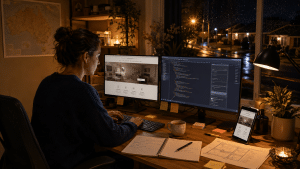
A strong Australian website should answer five questions quickly.
Who are you?
What do you offer?
Who do you help?
Why should the visitor trust you?
What should they do next?
If these answers are unclear, the design is doing too much visual work and not enough communication work.
1. Clear positioning
The homepage should explain your core offer in plain language. For example, a Melbourne accountant, a Sydney builder, or a Brisbane ecommerce brand should not rely on generic phrases such as “innovative solutions”. Instead, the page should explain the service, audience, location, and outcome.
A practical headline might be:
“Custom website design and development for growing Australian service businesses.”
That sentence is simple, but it tells users what the business does and who it helps.
2. Local trust signals
Australian buyers often look for signs that a provider understands local expectations. These can include:
- Australian phone number
- City or service area
- ABN or business details where relevant
- Client logos or testimonials
- Case studies
- Clear pricing guidance or project ranges
- Australian English spelling
- Local examples and industries
- Privacy, terms, and contact information
These details reduce uncertainty. As a result, users feel safer taking the next step.
3. Mobile-first experience
Many users will see your website on a phone before they see it on a desktop. Therefore, mobile design should not be treated as a smaller version of desktop design. It needs its own decisions.
Buttons need enough spacing. Forms need fewer fields. Menus need to be simple. Images need to be compressed. Calls to action should be visible without forcing the user to scroll endlessly.
4. Helpful content
Good web design development uses content as a conversion tool. Service pages should not only list features. They should explain problems, options, process, expected outcomes, and next steps.
For example, a page about website development should explain whether the business uses WordPress, Shopify, custom development, WooCommerce, Webflow, or another platform. It should also explain why that choice suits the client.
5. Conversion paths
Every key page needs a clear next step. This could be:
- Request a quote
- Book a consultation
- Call the team
- Download a guide
- View case studies
- Compare service packages
- Start a project enquiry
However, not every visitor is ready to buy. Therefore, include both direct and soft conversion options.
The web design development process
From my experience, website projects go wrong when businesses skip planning and jump straight into visual design. A good process avoids that. It creates shared expectations before design and code begin.
Numbered checklist: a practical onboarding process
- Clarify business goals
Decide whether the website needs more leads, ecommerce sales, bookings, enquiries, brand credibility, recruitment support, or customer education. - Define the target audience
Identify who the website must persuade. For example, a B2B buyer in Sydney may need detailed proof, while a local home service customer may need fast contact options. - Audit the current website
Review traffic, rankings, page speed, conversions, content quality, analytics, and technical issues. - Map the sitemap
Plan key pages before design starts. This may include homepage, service pages, location pages, industry pages, case studies, blog posts, and contact pages. - Prepare content requirements
Decide what copy, images, videos, testimonials, FAQs, and downloads are needed. - Create wireframes
Use wireframes to plan layout, hierarchy, user journeys, and calls to action before applying brand styling. - Design key templates
Create layouts for homepage, service page, blog post, contact page, and any landing pages. - Build the website
Develop the site in the chosen CMS or framework. Keep code clean, responsive, and maintainable. - Add SEO foundations
Include metadata, heading structure, internal links, schema where useful, image alt text, clean URLs, and indexation checks. - Test before launch
Test forms, links, mobile layouts, browser compatibility, page speed, redirects, analytics, and security basics. - Launch carefully
Move the site live with backups, redirects, DNS checks, and post-launch testing. - Improve after launch
Use analytics, search data, heatmaps, and customer feedback to refine pages over time.
This process works because it treats web design development as a business project, not only a creative task.
Onshore vs offshore web design development
Many Australian businesses compare local and offshore providers. Both can work. However, the best choice depends on budget, communication needs, complexity, and risk tolerance.
| Option | Best for | Advantages | Risks to manage |
| Onshore Australian team | Strategy-heavy projects, local SEO, regulated industries, complex stakeholder input | Easier communication, local market understanding, Australian English, timezone alignment | Usually higher upfront cost |
| Offshore team | Budget-sensitive builds, clearly scoped production tasks | Lower labour cost, scalable development capacity | Communication gaps, quality inconsistency, timezone delays |
| Hybrid model | Businesses needing local strategy plus cost-efficient production | Balance of local direction and production scale | Requires strong project management |
| In-house team | Ongoing digital product or frequent campaigns | Deep business knowledge and fast internal updates | Hiring cost, skills gaps, staff turnover |
For many small and medium Australian businesses, a hybrid approach can work well. For example, strategy, UX, copy, SEO, and project management can stay local, while selected development tasks can be handled by a trusted offshore team. However, quality control must stay strong.
SEO and content planning for web design development
SEO should not be added after launch. It should shape the website structure from the beginning. Otherwise, the site may look good but fail to attract search traffic.
Start with search intent
Search intent means the reason behind a query. Someone searching “web design development” may want definitions, pricing, process, examples, or help choosing a provider. Therefore, a strong page should answer several related questions instead of repeating the same phrase.
For Australian SEO, also consider local modifiers such as:
- web design development Australia
- website design and development Sydney
- web development agency Melbourne
- ecommerce website development Brisbane
- WordPress website design Australia
- small business website development Australia
However, keyword use must feel natural. Google’s guidance focuses on helpful, reliable, people-first content, so content should satisfy the reader before it tries to satisfy a keyword tool. The best pages explain topics clearly, show real expertise, and avoid thin or exaggerated claims.
Build service pages with depth
A service page should include more than a short description and a contact form. It should cover:
- What the service includes
- Who it is for
- Problems it solves
- Process and timelines
- Platform options
- Examples of deliverables
- FAQs
- Trust signals
- Related services
- Clear calls to action
This helps users make decisions. Additionally, it gives search engines more context.
Use internal linking carefully
Internal links help users and search engines discover important pages. For example, a web design page can link to SEO, ecommerce development, WordPress development, website maintenance, and case study pages.
For tailored support, explore RevgenX’s Australian website strategy and development services to plan a site around search visibility, user experience, and measurable business outcomes.
Avoid keyword stuffing
The focus keyphrase should appear naturally in the first paragraph, title, headings, and body copy. However, forcing it into every sentence can make the content awkward. Instead, use related terms such as website design, web development, UX design, front-end development, CMS setup, SEO foundations, and conversion optimisation.
Technical foundations: speed, security, accessibility, and tracking
A website can look polished but still perform poorly. Therefore, the technical layer matters.
Page speed
Fast pages improve user experience. They also reduce the chance that mobile visitors leave before the page loads. Large images, heavy scripts, poor hosting, unused plugins, and bloated themes are common causes of slow websites.
A good web design development team should compress images, use efficient code, choose reliable hosting, limit unnecessary scripts, and test important pages before launch.
Security
Security is not only an enterprise issue. Small businesses can also be exposed to phishing, weak passwords, outdated plugins, insecure forms, and poor access controls. The Australian Cyber Security Centre recommends practical basics for small businesses, including multi-factor authentication, software updates, and backups through its small business cyber security resources.
For website projects, this means:
- Use strong administrator passwords
- Enable multi-factor authentication where possible
- Keep CMS, plugins, and themes updated
- Use SSL certificates
- Limit admin access
- Back up the website regularly
- Protect forms from spam
- Monitor suspicious activity
These steps do not remove every risk. However, they reduce common problems.
Privacy and data handling
Many websites collect personal information through forms, analytics, ecommerce checkouts, booking tools, newsletter sign-ups, and CRM integrations. In Australia, privacy obligations can apply depending on the organisation and how information is handled. The Office of the Australian Information Commissioner explains the Australian Privacy Principles and notes that they are principles-based and technology neutral.
This article is not legal advice. In practical website administration, businesses should review what data they collect, why they collect it, how they store it, who can access it, and whether their privacy policy is clear and current. For regulated or complex situations, a licensed legal professional should review the final wording.
Accessibility
Accessibility means making websites easier to use for people with different abilities, devices, and contexts. It includes readable text, keyboard navigation, sufficient colour contrast, descriptive link text, alt text for meaningful images, and clear form labels.
Accessibility also improves general usability. For example, captions help people watching videos without sound. Clear labels help everyone complete forms faster. Better contrast helps people browsing outdoors on mobile.
Analytics and measurement
A website should launch with measurement in place. At a minimum, businesses should track:
- Form submissions
- Phone clicks
- Email clicks
- Booking actions
- Ecommerce purchases
- Important page views
- Search landing pages
- Traffic sources
- Conversion rates
Without analytics, decisions become guesswork. With analytics, you can see which pages attract visitors, which pages convert, and where users drop off.
Choosing the right platform
There is no single best platform for every Australian business. The right choice depends on goals, budget, content needs, integrations, and internal skills.
WordPress
WordPress is flexible and widely used. It suits service businesses, content-heavy sites, local SEO, blogs, landing pages, and many ecommerce projects using WooCommerce. However, it needs proper maintenance, security updates, and careful plugin selection.
Shopify
Shopify is popular for ecommerce because it handles hosting, checkout, product management, and many store features. It suits retailers that want a stable commerce platform without managing too much infrastructure. However, advanced customisation may require app subscriptions or specialist development.
Webflow
Webflow suits design-led marketing websites and teams that want visual editing with clean front-end output. It can work well for brochure sites, landing pages, and brand-focused websites. However, it may not suit every complex ecommerce or membership requirement.
Custom development
Custom development suits complex workflows, portals, SaaS products, booking systems, dashboards, and integrations that off-the-shelf platforms cannot handle. However, it needs a larger budget, clear documentation, and long-term technical support.
The best web design development decision is rarely about popularity alone. It should be based on business requirements.
Cost factors for web design development in Australia
Website pricing varies widely. A simple template-based small business site may cost far less than a custom ecommerce store or a complex web application.
Key cost factors include:
- Number of pages
- Custom design requirements
- Copywriting needs
- Photography or video
- SEO research
- Ecommerce features
- Booking or payment integrations
- CRM integrations
- Membership or portal features
- Migration from an old website
- Accessibility requirements
- Testing and quality assurance
- Hosting and maintenance
- Ongoing content support
Any price estimate should be treated as project-specific. A cheaper build may be fine for a basic brochure site. However, if the website must generate leads, support SEO, integrate with systems, and scale with campaigns, a higher-quality build often saves time later.
How long does web design development take?
Timelines depend on complexity. A small website can sometimes be completed in a few weeks if content, branding, and approvals are ready. A larger custom project may take several months.
Common delays include:
- Unclear scope
- Late content
- Too many decision makers
- Missing brand assets
- Slow feedback
- Complex integrations
- Unplanned features
- Poor migration planning
To keep the project moving, assign one internal decision maker, approve the sitemap early, prepare content before design approval, and keep feedback specific.
Common mistakes Australian businesses should avoid
Mistake 1: Designing before strategy
A website should not start with colours and homepage mockups. It should start with goals, audience, offers, search intent, and conversion paths.
Mistake 2: Copying competitors
Competitor research is useful. However, copying layouts, messaging, or service structures can make your brand look generic. Instead, use competitor research to find gaps and improve clarity.
Mistake 3: Ignoring mobile users
If a mobile visitor cannot read, tap, compare, or enquire easily, the design is not finished.
Mistake 4: Launching without redirects
If you replace an existing website, old URLs may need redirects. Otherwise, users and search engines may land on broken pages.
Mistake 5: Treating SEO as an afterthought
SEO needs structure, content, internal links, crawlability, metadata, and performance. Adding it later can mean reworking pages that should have been planned correctly.
Mistake 6: Using too many plugins
Plugins can add features quickly, especially in WordPress. However, too many plugins can create speed, security, and maintenance issues. Use only what is needed.
Mistake 7: Forgetting post-launch support
A website needs updates, backups, testing, security checks, and content improvements. Launch is the start of optimisation, not the end of the project.
People Also Ask
What does web design development include?
Web design development usually includes discovery, UX planning, visual design, copy structure, website development, CMS setup, SEO basics, testing, launch, and maintenance. In Australia, it may also include local SEO, privacy policy support, hosting advice, and conversion tracking.
How much does web design development cost in Australia?
Costs vary by scope, platform, page count, custom design, ecommerce needs, and integrations. A small business site may be relatively simple, while a custom ecommerce or portal project can require a much larger budget. Ask for a detailed scope, not just a single headline price.
Is web design development good for SEO?
Yes, when SEO is planned from the start. Site structure, page speed, mobile usability, content hierarchy, internal links, clean URLs, and indexation all affect how easily Google can understand and rank a website.
Should I choose WordPress, Shopify, or custom development?
Choose WordPress for flexible content and service websites, Shopify for ecommerce stores, and custom development for complex workflows or unique software needs. The best option depends on your goals, internal skills, budget, and long-term maintenance plan.
How do I choose a web design development agency in Australia?
Look for clear process, local market understanding, strong UX thinking, technical capability, SEO knowledge, transparent pricing, and post-launch support. Also ask for examples, timelines, ownership details, and how they handle revisions, testing, and maintenance.
Expert Q&A
1. What should be included in a web design development brief?
A strong brief should include business goals, target audience, current website problems, required pages, competitors, design preferences, functionality, SEO goals, content needs, integrations, budget range, timeline, and approval process. The clearer the brief, the easier it is to quote and deliver accurately.
2. How can a website generate better leads?
A website generates better leads when it speaks to the right audience, explains the offer clearly, proves trust, answers objections, and makes enquiry easy. Use focused service pages, strong calls to action, testimonials, case studies, FAQs, and short forms.
3. What is the role of UX in web design development?
UX, or user experience, shapes how easily visitors can understand and use the website. Good UX helps users find information, compare options, complete forms, and take action without confusion.
4. Why does website maintenance matter after launch?
Maintenance keeps the website secure, stable, accurate, and useful. It may include software updates, backups, broken link checks, content updates, analytics reviews, security monitoring, and performance improvements.
5. What questions should I ask before hiring a website team?
Ask who will manage the project, what platform they recommend, how they handle SEO, what is included in testing, who owns the website, what ongoing costs apply, and how updates are handled after launch. Also ask how they measure success.
Conclusion
Web design development is not only about making a site look modern. It is about building a digital asset that supports trust, search visibility, usability, security, and business growth. For Australian businesses, the best results come from combining clear strategy, helpful content, clean development, mobile-first UX, SEO foundations, and ongoing improvement.
Before you invest, define your goals, choose the right platform, plan your content, and work with a team that understands both design and technical delivery. To start with a practical, business-first approach, speak with RevGenX about Australian website strategy, design, and development that supports long-term digital growth.