
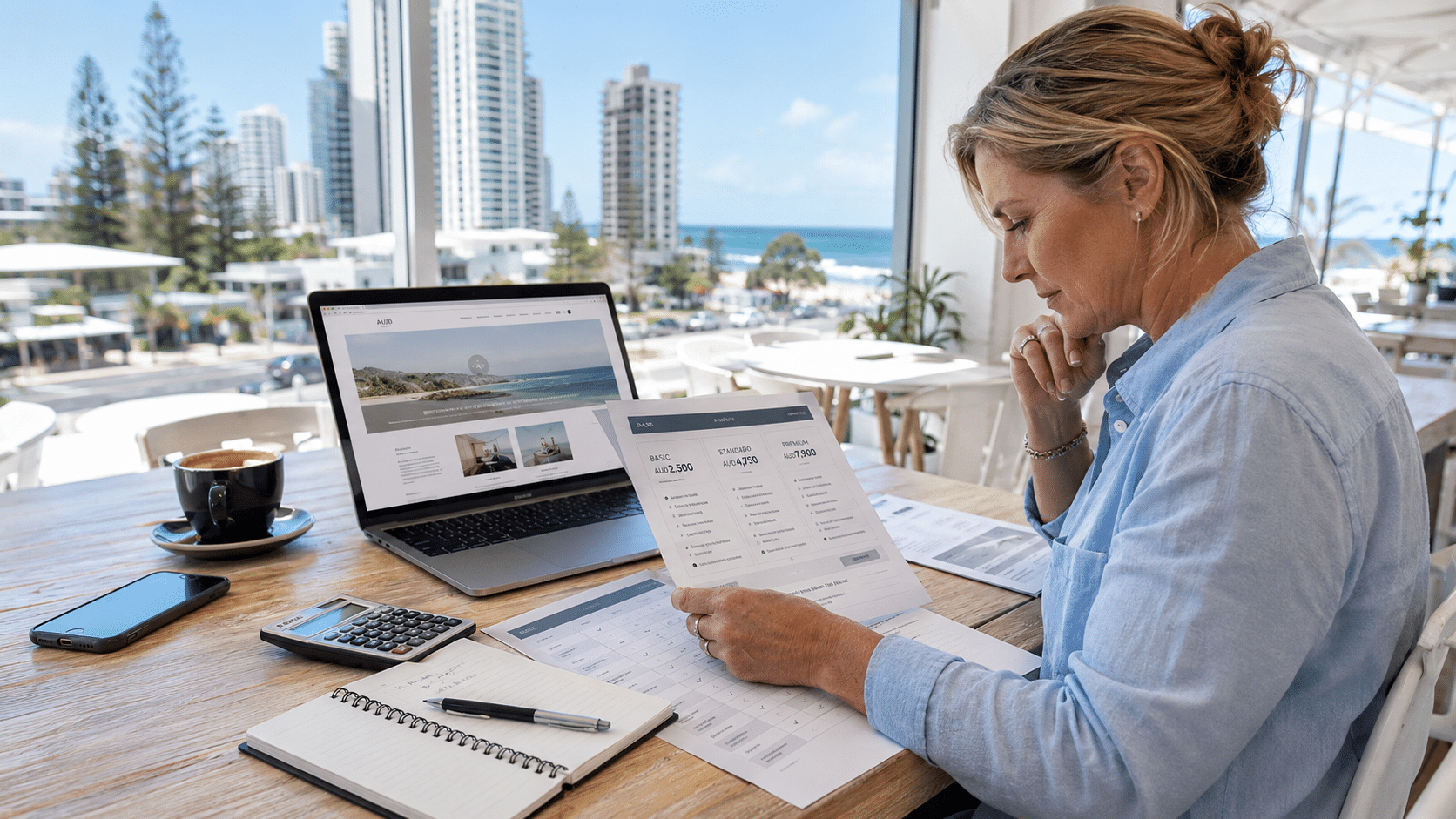
The cost of web design in Australia can feel confusing because every quote seems to include different pages, platforms, features, timelines, and levels of strategy. From my experience working with business website projects, the real question is not “What is the cheapest website?” It is “What does my business need the website to do, and what level of design, development, content, SEO, and support will help it do that properly?”
For many Australian businesses, a website is no longer just an online brochure. It may need to generate enquiries, support ecommerce, integrate with booking tools, explain services, meet accessibility expectations, load quickly on mobile, and help customers trust the brand before they make contact. Therefore, the cost of web design depends on scope, quality, complexity, and the amount of professional thinking included before the first page is built.
This guide explains realistic cost ranges, what affects pricing, how to compare quotes, and where Australian businesses can save money without cutting corners that matter.
Table of Contents
- What Is the Cost of Web Design?
- Why the Cost of Web Design Varies in Australia
- Typical Website Cost Ranges in Australia
- What Is Included in Professional Web Design Pricing?
- Onshore vs Offshore Web Design Costs
- Main Factors That Increase the Cost of Web Design
- Cost of Web Design by Business Type
- Ongoing Website Costs After Launch
- How to Budget for a Website in Australia
- Checklist: How to Get an Accurate Web Design Quote
- People Also Ask
- Q&A: Expert Questions About Web Design Costs
- Conclusion
What Is the Cost of Web Design?
The cost of web design in Australia usually ranges from a few thousand dollars for a simple small business website to tens of thousands for custom, ecommerce, or integration-heavy builds. Pricing depends on pages, design quality, content, SEO, platform, functionality, and ongoing support after launch.
Why the Cost of Web Design Varies in Australia
The cost of web design varies because “a website” can mean very different things.
A five-page service website for a local electrician is not the same as a custom ecommerce store with hundreds of products, shipping rules, payment gateways, email automation, CRM integration, and conversion tracking. Both are websites, but they require very different levels of planning, design, coding, testing, and support.
In Australia, pricing is also affected by local labour costs, agency overheads, project management, quality assurance, and the level of senior expertise involved. According to SEEK’s 2026 salary data, web developers in Australia commonly earn in the range of $75,000 to $95,000 per year. That helps explain why skilled Australian web design teams cannot price professional work at the same level as low-cost template-only providers.
There is also a strategic difference. A cheaper website may simply “exist” online. A better-planned website should support business goals such as enquiries, bookings, quote requests, online sales, recruitment, or trust-building.
From my experience, the biggest mistake business owners make is comparing web design quotes only by the final dollar amount. Instead, compare the scope, inclusions, exclusions, experience, communication process, and post-launch support.
Typical Website Cost Ranges in Australia
The following figures are general estimates for Australian businesses in 2026. They are not fixed prices because every project should be scoped properly.
| Website Type | Typical Estimated Cost in Australia | Best For | Common Inclusions |
| DIY website builder | $200–$1,500 per year plus time | Very small startups, testing ideas | Template, hosting plan, basic pages |
| Basic brochure website | $2,500–$6,000 | Sole traders, local services | 4–6 pages, contact form, mobile layout |
| Professional small business website | $6,000–$15,000 | Growing businesses | Custom design, CMS, SEO basics, analytics |
| Conversion-focused business website | $12,000–$30,000 | Lead generation, competitive industries | Strategy, copywriting, UX, speed, SEO setup |
| Ecommerce website | $8,000–$40,000+ | Online stores | Products, payments, shipping, stock structure |
| Custom web application or portal | $30,000–$100,000+ | Complex operations | Custom workflows, integrations, dashboards |
These ranges are estimates, but they reflect the practical reality of Australian web design projects. A business that only needs a credible online presence may not need a complex custom build. However, a business that relies on the website for revenue should usually invest more in structure, copy, conversion design, SEO, and performance.
What Is Included in Professional Web Design Pricing?
A good web design quote should show what is included. If it does not, you may be comparing an incomplete quote with a full-service quote.
Professional web design can include:
- Discovery and business requirements
- Competitor and audience research
- Sitemap planning
- User experience planning
- Wireframes or page structure
- Custom visual design
- Website development
- CMS setup, often WordPress, Shopify, or another platform
- Mobile responsive layouts
- Contact forms and lead capture
- Basic technical SEO
- Website speed optimisation
- Security setup
- Analytics and conversion tracking
- Testing before launch
- Training or handover
- Maintenance and support options
The more of these elements included, the higher the cost of web design will be. However, more inclusions can also reduce risk. For example, proper discovery can prevent expensive redesigns later. Good content structure can improve enquiries. Testing can prevent broken forms, layout problems, and mobile usability issues.
According to IBISWorld, web design services in Australia include web graphic design, search engine optimisation, programming, and coding. That matters because a proper website often needs more than visual design. It needs technical and marketing execution as well.
Onshore vs Offshore Web Design Costs
Australian businesses often compare local agencies, freelancers, offshore teams, and hybrid models. Each option can work, but each has trade-offs.
| Option | Typical Cost Level | Advantages | Risks or Trade-Offs |
| Australian agency | Higher | Local market understanding, strategy, accountability, broader team | Higher upfront cost |
| Australian freelancer | Medium | Direct communication, flexible pricing | Limited capacity if project grows |
| Offshore team | Lower to medium | Lower production cost, scalable labour | Communication gaps, quality control, time zones |
| Hybrid model | Medium | Local strategy with offshore production support | Needs strong project management |
| DIY builder | Lowest cash cost | Fast, cheap, simple | Time cost, limited customisation, weaker strategy |
A local Australian team may cost more, but it often brings better understanding of local search behaviour, Australian English, trust signals, customer expectations, and common business requirements such as GST display, local payment methods, and location-based service pages.
Offshore web design can be suitable for defined production tasks. However, it becomes risky when the project needs brand strategy, conversion copy, technical SEO, accessibility awareness, or close collaboration with internal teams.
Main Factors That Increase the Cost of Web Design
Several factors can raise the cost of web design. Understanding them helps you control your budget.
1. Number of Pages
A small website may only need Home, About, Services, Contact, and one or two supporting pages. However, many Australian businesses need separate pages for each service, industry, location, or product category.
More pages mean more planning, copywriting, design, development, internal linking, and testing.
2. Custom Design Requirements
A template-based website is cheaper because much of the design system already exists. A custom website costs more because the layout, brand styling, user journey, and page sections are designed around your business.
Custom design is usually worth considering when your brand needs to stand out, your services are complex, or your website is expected to generate serious leads.
3. Copywriting and Content
Many website delays happen because the business owner plans to write the content but does not have time. Professional copywriting increases the project cost, but it can improve clarity, trust, SEO, and conversion.
Good copy explains what you do, who you help, why you are different, and what the visitor should do next. It also reduces vague claims and makes your offer easier to understand.
4. SEO Setup
Basic SEO may include titles, meta descriptions, heading structure, image alt text, indexability checks, and clean URL structure. More advanced SEO may include keyword mapping, content strategy, schema markup, technical audits, internal linking, and location landing pages.
The cost of web design increases when SEO is included properly because SEO requires research and implementation. However, skipping SEO can mean paying for a website that looks good but struggles to attract organic traffic.
5. Ecommerce Functionality
Ecommerce usually costs more because there are more moving parts. Product pages, categories, payments, shipping, tax settings, stock management, checkout design, abandoned cart tools, and customer emails all need careful setup.
For Australian businesses, ecommerce may also involve GST display, Australia Post or courier integrations, local payment gateways, and clear refund or shipping information. These are administrative and operational considerations, not legal advice.
6. Booking, CRM, and Third-Party Integrations
A basic contact form is simple. However, integrations with HubSpot, Salesforce, Mailchimp, Xero, Calendly, booking systems, inventory tools, or custom APIs require more development and testing.
Integrations can save time after launch, but they should be scoped early. Otherwise, they can become unexpected costs.
7. Accessibility and Usability
Accessibility means making your website easier for people with different abilities to use. It includes readable text, keyboard navigation, colour contrast, alt text, form labels, and logical page structure.
The global WCAG 2.2 standard is widely used as a reference for web accessibility. While not every small business website needs enterprise-level accessibility work, usability and accessibility should still be considered during design.
8. Website Performance
Fast websites usually require better hosting, optimised images, clean code, caching, and careful plugin selection. Performance matters because slow pages can frustrate users and reduce enquiries.
Speed work can increase development time, but it often improves the user experience.
9. Compliance and Administrative Setup
Some businesses need privacy policy pages, cookie notices, terms pages, accessibility notes, or industry-specific disclaimers. These should be treated as administrative and compliance-support tasks.
A web designer can create the page structure and placement, but legal wording should be reviewed by a qualified professional where needed.
The Australian Government’s business.gov.au support portal is a useful starting point for general business information, registrations, grants, and support services.
Cost of Web Design by Business Type
Different businesses need different website budgets.
Local Service Businesses
Examples include plumbers, electricians, cleaners, builders, mechanics, accountants, and consultants.
A local service website may cost between $4,000 and $15,000, depending on the number of services and locations. The website should clearly explain services, suburbs served, proof of work, reviews, licences where relevant, and contact options.
For these businesses, the best value often comes from strong service pages, clear calls to action, and local SEO foundations.
Professional Services
Examples include legal firms, finance brokers, architects, migration consultants, NDIS providers, and business advisors.
These websites often cost between $8,000 and $25,000 because trust, compliance wording, service clarity, and content depth matter. The design needs to feel credible, but the copy also needs to explain complex services in plain English.
Ecommerce Businesses
An ecommerce website may cost from $8,000 to $40,000 or more. The range is wide because a store with 20 products is very different from a store with 2,000 products, custom shipping rules, wholesale pricing, and inventory integrations.
Shopify, WooCommerce, BigCommerce, and Magento-style platforms all have different cost structures. Therefore, platform choice should be based on business needs, not just design preference.
Trades and Construction
Trades and construction websites often need strong project galleries, service-area pages, quote forms, before-and-after images, and trust signals such as insurance, certifications, and client reviews.
A practical budget may sit between $5,000 and $18,000. However, larger construction companies may need more content, case studies, tender support information, and recruitment pages.
Startups
Startups often need to balance speed and cost. A simple launch website may cost $3,000 to $10,000. However, a SaaS product, marketplace, or web app can cost far more because it requires product design, user accounts, dashboards, payments, and custom development.
For startups, phased delivery is often smart. Start with a strong marketing website or MVP, then improve after real user feedback.
Ongoing Website Costs After Launch
The cost of web design does not end when the website goes live. Every website has ongoing costs.
Common ongoing costs include:
| Ongoing Item | Typical Estimate | Why It Matters |
| Domain name | $20–$80 per year | Keeps your website address active |
| Hosting | $15–$300+ per month | Affects speed, uptime, security |
| SSL certificate | Often included to $200+ per year | Supports secure browsing |
| CMS updates | $50–$300+ per month | Reduces security and compatibility risk |
| Backups | Included to $100+ per month | Helps recovery after errors |
| Content updates | Variable | Keeps information current |
| SEO support | $800–$5,000+ per month | Builds visibility over time |
| Conversion optimisation | Variable | Improves enquiry or sales rate |
According to the Australian Taxation Office, businesses may be able to claim deductions for digital product expenses used in running the business, depending on whether the expense is operating or capital in nature. The ATO’s guidance on digital product expenses also notes that records must be kept to prove expenses and calculations.
This is general administrative information, not tax advice. Ask a registered tax agent or accountant how website costs should be treated for your business.
How to Budget for a Website in Australia
A practical website budget should be based on commercial value, not just page count.
Start with the role of the website. Does it need to generate leads? Sell products? Support customer service? Attract staff? Explain a complex service? Replace manual admin? The more business value it needs to create, the more planning and quality matter.
A useful budgeting rule is to separate the project into four layers.
Layer 1: Essential Setup
This includes domain, hosting, CMS, security, mobile responsiveness, basic pages, contact forms, and launch testing.
This layer gets the website online. However, it may not be enough to compete in search or convert visitors.
Layer 2: Trust and Content
This includes copywriting, service pages, case studies, testimonials, FAQs, team profiles, and clear calls to action.
This layer helps visitors understand and trust the business.
Layer 3: Growth and SEO
This includes keyword research, technical SEO, content planning, local SEO, analytics, conversion tracking, and structured internal linking.
This layer helps the website become a marketing asset.
Layer 4: Automation and Integration
This includes CRM connections, booking systems, payment tools, email marketing, dashboards, and custom workflows.
This layer saves time and improves operations, but it needs more investment.
How to Compare Web Design Quotes
Two web design quotes may look similar but include very different work.
A $4,000 quote may include a template, basic pages, and limited revisions. A $12,000 quote may include research, copywriting, custom design, SEO setup, analytics, training, and post-launch support.
When comparing quotes, ask:
- Is the design custom or template-based?
- Who writes the content?
- Is SEO research included?
- How many pages are included?
- Are revisions included?
- Is mobile design tested?
- Is speed optimisation included?
- Are plugins, licences, or subscriptions extra?
- Is training included?
- What happens after launch?
- Who owns the website, content, and accounts?
- What is excluded?
The cheapest quote is not always bad. The highest quote is not always best. However, the right quote should make the scope, process, assumptions, and deliverables clear.
Checklist: How to Get an Accurate Web Design Quote
Use this numbered checklist before asking for quotes. It will save time and reduce vague pricing.
- Define the business goal. Decide whether the website should generate leads, sell products, build authority, support recruitment, or reduce admin.
- List the required pages. Include Home, About, Services, Contact, FAQs, case studies, locations, products, resources, and policy pages.
- Clarify your audience. Note whether you are targeting homeowners, businesses, government buyers, ecommerce customers, local suburbs, or national Australian searches.
- Gather brand assets. Prepare your logo, colours, fonts, photography, videos, brochures, and existing brand guidelines.
- Decide who writes content. Confirm whether you will supply copy or need professional website copywriting.
- List required features. Include forms, booking tools, payments, ecommerce, member areas, calculators, chat, maps, or downloads.
- Identify integrations. List tools such as CRM, email marketing, Xero, payment gateways, inventory systems, or scheduling software.
- Set SEO expectations. Decide whether you need basic SEO setup, local SEO, content strategy, or ongoing SEO support.
- Confirm compliance needs. Note privacy, accessibility, industry disclaimers, or policy pages that may need professional review.
- Ask about support. Clarify maintenance, hosting, backups, updates, training, and post-launch changes.
How to Reduce the Cost of Web Design Without Hurting Quality
You can reduce the cost of web design without choosing the cheapest possible option.
First, reduce uncertainty. Clear requirements save quoting time and reduce rework. If your designer knows the pages, features, content needs, and integrations from the start, the quote will be more accurate.
Second, start with a focused first version. Instead of building every possible feature, launch the pages and functionality that matter most. Then improve based on user behaviour.
Third, prepare content early. Even rough notes, service descriptions, customer questions, and examples of past work help the copywriting process.
Fourth, avoid unnecessary custom functionality. Many businesses do not need a custom booking system if a reliable third-party tool already exists.
Finally, invest in the areas that affect results. A cheap site with weak messaging, poor mobile usability, and no SEO structure may cost more in lost opportunities than it saves upfront.
When a Cheap Website Makes Sense
A cheap website can make sense when the business is new, the offer is still being tested, the budget is very limited, or the website is not yet a major sales channel.
For example, a new sole trader may start with a simple website builder to validate demand. That can be a sensible first step.
However, once the business depends on trust, leads, bookings, or online sales, a cheap website can become limiting. It may be hard to customise, slow to load, weak for SEO, or difficult to scale.
The best approach is not always expensive. It is appropriate. Match the investment to the business stage and website goals.
When a Higher Web Design Budget Is Worth It
A higher budget is often worth it when the website directly affects revenue.
This includes businesses in competitive search markets, ecommerce brands, professional services, high-ticket services, and companies that need stronger trust signals.
A higher budget may also be justified when the website needs integrations, custom user journeys, complex content, strong technical SEO, or conversion-focused design.
From my experience, businesses often see better value when they spend more on planning and messaging before design begins. A beautiful website with unclear messaging will still underperform.
Common Hidden Costs in Web Design
Hidden costs are not always caused by bad intent. Often, they happen because assumptions were not discussed early.
Watch for these common items:
- Premium plugins or app subscriptions
- Stock images or custom photography
- Copywriting
- Product data entry
- Website migration
- Redirects from old URLs
- Advanced SEO setup
- Speed optimisation
- Accessibility improvements
- CRM or email marketing integration
- Training sessions
- Post-launch support
- Extra revision rounds
- Hosting upgrades
Before signing a proposal, ask what is included, what is optional, and what may cost extra later.
People Also Ask
How much does web design cost in Australia?
The cost of web design in Australia can range from a few thousand dollars for a simple website to $30,000 or more for a custom or ecommerce website. The final price depends on pages, functionality, content, SEO, integrations, and the level of design quality.
Why do web design quotes vary so much?
Quotes vary because some include only visual design and basic development, while others include strategy, copywriting, SEO, testing, analytics, and support. Therefore, always compare inclusions rather than price alone.
Is WordPress cheaper than a custom website?
WordPress can be cheaper when it uses an existing theme or common plugins. However, a highly customised WordPress website can still cost a lot because strategy, design, development, content, and testing take professional time.
Should I choose a freelancer or agency for web design?
A freelancer may suit a smaller, clearly defined project. An agency may be better when you need strategy, design, development, copywriting, SEO, project management, and ongoing support from one team.
How much should a small business spend on a website?
A small Australian business may spend $4,000 to $15,000 for a professional website, depending on goals and complexity. If the website is a key sales channel, a higher budget may be reasonable.
Q&A: Expert Questions About Web Design Costs
1. What is the biggest driver of the cost of web design?
The biggest driver is usually complexity. A simple website with a few static pages costs less than a site with custom layouts, ecommerce, integrations, SEO planning, copywriting, and conversion-focused design.
2. Can I pay for web design monthly instead of upfront?
Some providers offer monthly website packages. This can help cash flow, but you should check ownership, contract terms, hosting control, cancellation rules, and what happens if you stop paying.
3. Does a more expensive website always perform better?
No. A higher price does not guarantee better results. Performance depends on strategy, audience fit, content quality, technical execution, SEO, speed, and ongoing improvement.
4. Should SEO be included in the website build?
Basic SEO should usually be included in a professional build. However, ongoing SEO is a separate activity because rankings often require content, authority building, technical improvements, and regular optimisation.
5. How often should a business redesign its website?
Many businesses review their website every two to three years, but timing depends on performance. If the website is slow, hard to update, off-brand, weak on mobile, or not generating enquiries, it may need improvement sooner.
Conclusion
The cost of web design in Australia depends on what your website needs to achieve. A basic website may be enough for a new or very small business, while a growing business may need custom design, stronger content, SEO, ecommerce, integrations, and ongoing support.
The smartest approach is to define your goals, clarify your scope, compare inclusions carefully, and invest where the website can create business value. A good website should not just look professional. It should help people understand your offer, trust your business, and take the next step.
For a practical, growth-focused approach to planning your next website, explore RevgenX’s web design and digital growth support.