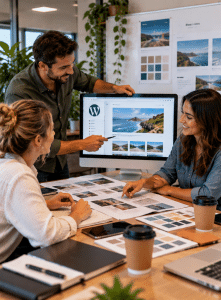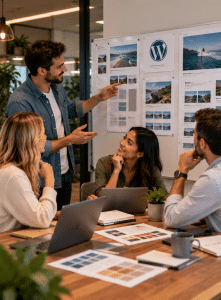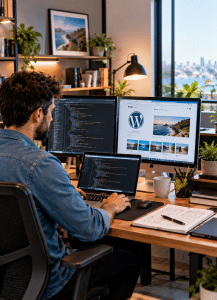


Website development using wordpress is one of the most practical ways for Australian businesses to build a flexible, search-friendly and manageable online presence without locking every small change behind a developer. From my experience working with service-based businesses, the best WordPress projects are not just “pretty websites”. They are planned around customer journeys, clear offers, local trust signals, fast loading, SEO structure, security and simple admin workflows.
Today, Australian customers compare businesses quickly. They expect a site to load well on mobile, explain services clearly, show proof, make contact easy and feel trustworthy. Therefore, your WordPress website needs more than a theme and a few pages. It needs strategy, structure and ongoing care.
What Is Website Development Using WordPress?
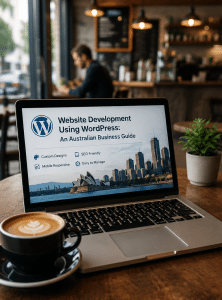
Website development using wordpress means planning, designing, building and maintaining a website with WordPress as the content management system. It includes page structure, custom design, mobile responsiveness, SEO setup, plugins, forms, hosting, security, speed optimisation and content editing tools that help Australian businesses manage their website after launch.
Table of Contents
- Why WordPress suits Australian business websites
- What makes WordPress development different from basic web design?
- Website development using WordPress: core project stages
- Australian business requirements to consider
- Custom WordPress vs template WordPress
- Onshore vs offshore WordPress development comparison
- Essential features for a high-performing WordPress website
- SEO planning for WordPress in Australia
- Security, privacy and admin considerations
- WordPress website development checklist
- Common mistakes to avoid
- People Also Ask
- Expert Q&A
- Conclusion
Why WordPress Suits Australian Business Websites
WordPress remains popular because it gives businesses control. According to W3Techs WordPress usage data, WordPress powers a large share of websites globally, including many sites that use a known content management system. That matters because a widely used platform usually has strong community support, plugin options, documentation and developer availability.
For Australian businesses, WordPress is useful because it can support many website types. For example, a Sydney consultant may need a lead generation site. A Melbourne trade business may need service area pages. A Brisbane allied health clinic may need appointment forms and privacy-friendly content. An Adelaide ecommerce brand may need WooCommerce, payment gateways and shipping rules.
However, WordPress is not automatically successful. The platform gives you tools, but the outcome depends on planning, development quality, content and maintenance. In other words, website development using wordpress works best when it is treated as a business system, not just a design task.
What Makes WordPress Development Different From Basic Web Design?
Basic web design often focuses on layout, colours and visual style. WordPress development goes deeper. It turns a website concept into a working, editable and scalable digital asset.
A proper WordPress development process usually includes:
- Business and audience research
- Sitemap planning
- UX wireframes
- Responsive design
- Theme or custom theme development
- Plugin selection and configuration
- SEO foundations
- Page speed optimisation
- Security setup
- Forms, tracking and conversion points
- Content entry and formatting
- Testing before launch
- Ongoing updates and support
This is why a cheap website can become expensive later. If the site is hard to edit, slow, poorly structured or plugin-heavy, you may need to rebuild it sooner than expected. Therefore, good development decisions at the start can reduce friction later.
Website Development Using WordPress: Core Project Stages
A reliable WordPress project should move through clear stages. This keeps the build organised and helps business owners understand what they are paying for.
1. Discovery and Goal Setting
First, define the purpose of the site. A website for a law firm, café, NDIS provider, construction company and SaaS business will not need the same structure.
At this stage, clarify:
- Who the target audience is
- Which locations matter in Australia
- What services or products need priority
- What actions users should take
- What content already exists
- Which competitors appear in Google
- What systems need to connect, such as CRM, email marketing or booking tools
From my experience, this stage prevents vague websites. Instead of saying “we need a modern website”, the business can say “we need local service pages that bring qualified enquiries from Perth homeowners”.
2. Sitemap and Content Planning
Next, plan the sitemap. This is the page structure of your website. It may include Home, About, Services, Service Area pages, Case Studies, Blog, Contact and legal/admin pages.
For SEO, each major service should usually have its own page. For example, a business offering WordPress design, WordPress development and website care plans should avoid placing everything on one generic page. Separate pages help Google and users understand relevance.
Additionally, Australian businesses should consider local search intent. People often search with city, suburb or region terms. Therefore, a useful structure may include location-specific pages where there is genuine service coverage and helpful local information.
3. UX and Wireframing
Wireframes are simple layouts that show page sections before final design. They help answer questions such as:
- What should appear above the fold?
- Where should calls to action sit?
- How should services be grouped?
- What proof should appear on key pages?
- How quickly can users contact the business?
Good UX reduces confusion. For example, a visitor should not need to scroll through five paragraphs before understanding what you offer. Likewise, contact details should be easy to find on mobile.
4. Visual Design
Design should support trust and usability. It includes colours, typography, spacing, imagery, icons and layout style.
For Australian audiences, clarity often matters more than hype. A clean website with specific service information, real proof and fast access to contact options will usually perform better than a flashy site with vague promises.
Design also needs to account for accessibility. This means readable text, strong contrast, keyboard-friendly navigation, descriptive links and sensible heading order.
5. WordPress Development
During development, the approved design becomes a working WordPress site. This may involve a custom theme, a block-based build, a page builder or a hybrid approach.
The right method depends on budget, editing needs and long-term plans. For example, a small business may need an efficient build using a lightweight theme and editor-friendly blocks. A growing company may need custom post types, advanced integrations and stricter design controls.
6. Content Entry and On-Page SEO
Once the site is built, content must be entered properly. This includes headings, internal links, images, metadata, schema where relevant and clear calls to action.
Website development using wordpress should also include basic SEO setup. That does not mean keyword stuffing. Instead, it means each page has a clear topic, helpful content, logical headings and search-friendly metadata.
7. Testing and Launch
Before launch, test the website across devices and browsers. Check forms, buttons, page speed, redirects, analytics, menus, image sizes and mobile layouts.
This stage is important because small issues can hurt enquiries. For example, a broken contact form can waste paid traffic and organic visitors. Therefore, launch testing should be treated as a business-critical step.
8. Maintenance and Improvement
After launch, WordPress needs ongoing care. This includes plugin updates, theme updates, backups, uptime checks, security monitoring and content improvements.
A website is not finished forever on launch day. Search behaviour changes, competitors improve and your services may evolve. As a result, ongoing optimisation helps the site stay useful.
Australian Business Requirements to Consider
Australian businesses should treat compliance-related website tasks as admin and risk-management items, not as afterthoughts. This is not legal advice, and businesses should get qualified advice for specific obligations. However, several practical areas matter.
Privacy and Personal Information
If your website collects personal information through forms, bookings, newsletter signups or ecommerce checkout, you should understand privacy obligations. The Office of the Australian Information Commissioner explains the Australian Privacy Principles, which guide how personal information is handled by covered organisations.
For website projects, this may affect:
- Privacy policy content
- Form consent wording
- Data storage practices
- Third-party tools
- Email marketing opt-ins
- Analytics and tracking choices
Even when a small business is not sure which rules apply, it is sensible to minimise unnecessary data collection and be transparent with users.
Cyber Security
WordPress security is not just a technical concern. It protects customer trust, business continuity and website performance. The Australian Cyber Security Centre small business guide recommends practical measures such as multi-factor authentication, software updates and backups.
For WordPress, that usually means:
- Strong admin passwords
- Multi-factor authentication
- Regular plugin and theme updates
- Security monitoring
- Reliable backups
- Limited admin access
- Secure hosting
- SSL certificates
- Careful plugin selection
Because WordPress is widely used, poorly maintained sites can become targets. Therefore, maintenance is not optional for serious business websites.
Accessibility
Accessibility means making your website easier for more people to use, including people using assistive technologies. It also improves general usability.
In practical terms, this includes:
- Clear text hierarchy
- Alt text for meaningful images
- Keyboard-friendly navigation
- Descriptive button text
- Good colour contrast
- Captions or transcripts for key media
- Avoiding tiny text on mobile
Accessibility should be built into the process rather than patched later.
Australian English and Local Trust
Use Australian English spelling and terms where relevant. For example, write “optimise”, “organisation”, “enquiry” and “local business” where appropriate.
You should also show local trust signals. These may include Australian phone numbers, service areas, local case studies, ABN details if appropriate, Australian testimonials and clear business hours.
Custom WordPress vs Template WordPress
Both custom and template WordPress websites can work. The best choice depends on your goals.
| Option | Best For | Benefits | Trade-Offs |
| Template WordPress website | Startups, micro businesses, simple brochure sites | Lower cost, faster launch, easier starting point | Less unique, may include unused features, can be harder to scale |
| Custom WordPress website | Growing businesses, service brands, complex content needs | Better fit, stronger UX, cleaner code potential, more control | Higher upfront cost, requires better planning |
| Hybrid WordPress build | SMEs wanting balance | Custom key pages with efficient reusable blocks | Needs clear design rules to avoid inconsistency |
A template can be suitable when the budget is limited and the website needs are simple. However, a custom approach is often better when your business relies on organic traffic, lead quality and brand differentiation.
From my experience, the problem is rarely “template versus custom” by itself. The real issue is whether the site is planned around the customer journey. A well-planned template site can outperform a poorly planned custom site. However, a well-planned custom WordPress site gives more room for growth.
Onshore vs Offshore WordPress Development Comparison
Many Australian businesses compare local and offshore providers. Both models can work, but they suit different situations.
| Factor | Onshore Australian Developer | Offshore Developer |
| Communication | Easier time zones, local context, clearer calls | May require async communication and tighter briefs |
| Local SEO understanding | Usually stronger for Australian suburbs, states and search intent | Varies by provider |
| Cost | Often higher upfront | Often lower upfront |
| Quality control | Easier workshops and review cycles | Needs detailed documentation |
| Compliance/admin awareness | More likely to understand Australian privacy, accessibility and business expectations | May need guidance |
| Best fit | Strategy-led projects, local service businesses, complex discovery | Clearly scoped production tasks or budget-sensitive builds |
The right choice depends on your internal capacity. If you can write detailed briefs, review work carefully and manage quality, offshore support may help. However, if you need strategy, local SEO planning and business guidance, an Australian-led process can reduce risk.
Essential Features for a High-Performing WordPress Website
A strong WordPress website should include features that support users and business goals.
Clear Navigation
Menus should be simple. Avoid hiding important services under vague labels. For example, “Services” is clearer than “Solutions” for many small business websites.
Strong Service Pages
Each service page should explain:
- Who the service is for
- What problem it solves
- What is included
- How the process works
- Why your business is credible
- What the next step is
This helps both users and search engines.
Mobile-First Design
Most users will view your site on a mobile device at some point. Therefore, buttons, forms, menus and content blocks must work well on smaller screens.
Fast Loading
Speed affects user experience. Large images, heavy themes and too many plugins can slow down a site. Use compressed images, caching, quality hosting and lightweight design choices.
Conversion Points
Every key page should guide users toward a next step. This could be a contact form, phone number, quote request, booking link, download or email signup.
However, avoid aggressive pop-ups that interrupt users. In Australia, trust and clarity often work better than pressure tactics.
Analytics and Tracking
Set up analytics so you can see what is working. At a basic level, track visits, enquiry forms, phone clicks and important page performance.
This helps you improve the website over time instead of guessing.
SEO Planning for Website Development Using WordPress in Australia
SEO should be planned before development, not added at the end. When SEO is left too late, the site may need rework.
Keyword Mapping
Keyword mapping means assigning each important search topic to a specific page. For example:
- “website development using wordpress” may suit a guide or service page
- “WordPress developer Sydney” may suit a location page
- “WordPress maintenance Australia” may suit a support service page
- “WooCommerce development” may suit an ecommerce service page
This prevents multiple pages from competing for the same keyword.
Search Intent
Search intent means the reason behind the search. Someone searching “what is WordPress development” wants education. Someone searching “WordPress developer near me” likely wants a provider.
Your content should match the intent. For this article, the intent is informational with commercial investigation. The reader wants to understand website development using wordpress before choosing a provider.
Internal Linking
Internal links help users and search engines move through your site. For example, a blog about planning a website can link to a WordPress development service page.
For support with strategy, design and development, explore RevgenX’s WordPress website development services.
Local Relevance
Australian SEO should include relevant location signals where genuine. This may include city pages, service area content, local case studies and references to Australian business needs.
However, avoid creating thin suburb pages that repeat the same text. Google and users both prefer useful, specific content.
Content Quality
Good SEO content answers real questions. It should explain terms, compare options, show processes and help readers make decisions.
For website development using wordpress, useful content may include:
- Cost guides
- Planning checklists
- Platform comparisons
- Maintenance guides
- Security basics
- SEO setup guides
- Case study breakdowns
Security, Privacy and Admin Considerations
WordPress can be secure, but it must be managed properly. Many issues come from weak passwords, outdated plugins, poor hosting or unnecessary admin access.
Plugin Management
Plugins add features, but too many plugins can create performance and security risks. Choose plugins carefully. Check update history, reviews, support quality and whether the feature is truly needed.
User Roles
Not every team member needs administrator access. WordPress includes roles such as Editor and Author. Use the lowest access level that allows the person to do their job.
Backups
Backups should run automatically and be stored safely. Test restoration if the website is important to revenue. A backup that cannot be restored is not very useful.
Privacy Admin
For Australian websites, privacy admin may include reviewing forms, cookie tools, analytics settings and third-party scripts. This should be checked by someone qualified where obligations are unclear.
Maintenance Schedule
A simple maintenance plan may include:
- Weekly plugin and theme checks
- Daily or weekly backups
- Monthly speed checks
- Security scans
- Broken link checks
- Content updates
- Quarterly SEO review
This helps keep the website healthy after launch.
Numbered Checklist: WordPress Website Onboarding Steps
Use this checklist before starting website development using wordpress.
- Define your primary business goal, such as enquiries, bookings or sales.
- List your target locations in Australia.
- Identify your top services or products.
- Collect brand assets, including logo, colours and images.
- Review competitor websites and note what users may expect.
- Create a sitemap with priority pages.
- Prepare draft content for each core page.
- Decide what forms, bookings or integrations are needed.
- Confirm hosting, domain and email access.
- Plan privacy, security and admin requirements.
- Approve wireframes before final design.
- Test the website on mobile, tablet and desktop.
- Check forms, analytics, metadata and redirects before launch.
- Set up ongoing updates, backups and support.
This process reduces delays. It also gives the developer enough information to build a website that supports real business outcomes.
Common Mistakes to Avoid
Choosing Design Before Strategy
A beautiful website can still fail if it does not answer customer questions. Start with goals, pages and messaging before visual polish.
Using Too Many Plugins
Plugins are useful, but every plugin adds weight and possible risk. Choose fewer, better tools.
Ignoring Mobile Users
Mobile experience is not optional. If menus, buttons or forms are difficult on mobile, enquiries can drop.
Writing Generic Content
Generic content does not build trust. Instead, explain your process, show local relevance and answer buyer questions clearly.
Forgetting Maintenance
WordPress needs updates. Without maintenance, the site can become slower, less secure and harder to manage.
Not Planning SEO Early
SEO affects site structure, URLs, headings and content. Therefore, it should be part of the build from the start.
People Also Ask: Website Development Using WordPress in Australia
Is WordPress good for Australian business websites?
Yes, WordPress is a strong option for many Australian business websites because it is flexible, widely supported and easy to manage after launch. However, results depend on good planning, quality development, secure hosting and ongoing maintenance.
How much does website development using WordPress cost in Australia?
Costs vary widely based on scope, design quality, page count, integrations, copywriting and SEO needs. A simple small business site may cost much less than a custom website with booking systems, ecommerce or advanced content structures.
Is WordPress better than Wix or Squarespace?
WordPress usually offers more flexibility, ownership and scalability. Wix and Squarespace can be easier for very simple sites, but WordPress is often better when you need custom SEO structure, integrations, advanced content or long-term growth.
Do I need a developer for WordPress?
You can build a basic WordPress site yourself, but a developer helps with structure, performance, security, responsive design and custom features. For business-critical websites, professional development usually reduces risk.
How long does a WordPress website take to build?
A small WordPress website may take a few weeks once content is ready. A larger custom project can take longer because it involves discovery, design, development, testing, revisions and launch preparation.
Expert Q&A: Deeper Questions About Website Development Using WordPress
1. What is the difference between WordPress.com and WordPress.org?
WordPress.org refers to the open-source WordPress software that you install on your own hosting. WordPress.com is a hosted platform with managed plans. For business website development using wordpress, many agencies use self-hosted WordPress because it offers more control over hosting, plugins, customisation and technical SEO.
2. Should my Australian business use WooCommerce?
WooCommerce can be a good choice if you want ecommerce inside WordPress. It is useful for businesses that need product pages, online payments, shipping settings and content marketing in one platform. However, it needs proper setup, secure payments, performance optimisation and ongoing maintenance.
3. Can WordPress handle a custom design?
Yes. WordPress can support fully custom designs, reusable content blocks and tailored layouts. A custom design is helpful when your brand, sales process or content needs are different from a standard template. However, custom design should still be easy for your team to edit.
4. What should I prepare before hiring a WordPress developer?
Prepare your goals, target audience, services, preferred pages, examples of websites you like, brand assets, content drafts and required integrations. Also confirm access to your domain, hosting, Google tools and current website if you have one.
5. How often should a WordPress website be updated?
WordPress core, themes and plugins should be reviewed regularly. Many businesses check updates weekly or monthly, depending on complexity and risk. Critical security updates should be handled quickly. Backups should run before major updates.
Conclusion
Website development using wordpress can give Australian businesses a flexible, SEO-friendly and scalable website when it is done properly. The key is to plan before building. Start with business goals, audience needs, page structure and search intent. Then design for clarity, develop for performance and maintain the site after launch.
WordPress is powerful, but it is not magic. A successful website needs useful content, fast pages, strong security, clear calls to action and ongoing improvement. Therefore, treat your website as a business asset, not a one-time design expense.
If you are planning a new WordPress website, begin with a clear sitemap, a realistic content plan and a maintenance approach. With the right process, your website can support visibility, trust and better enquiries from Australian customers.